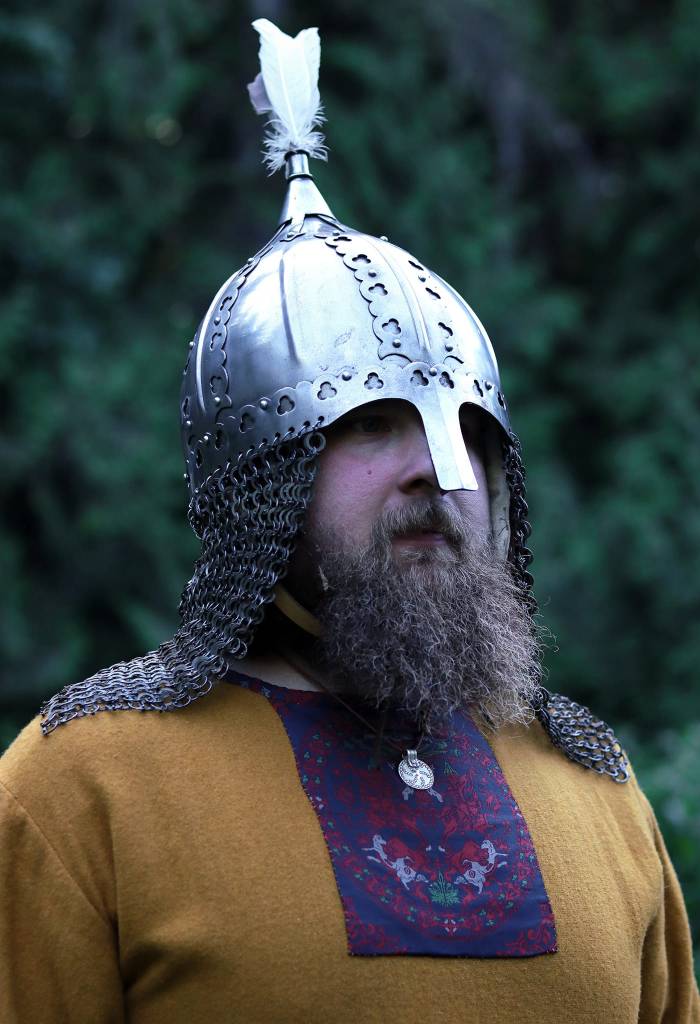
NWVA Elder William in his Gnezdovo type 2 helmet and yellow Rus tunic.
The archaeological site of Gnezdovo has produced two helmets (along with a depiction of an ocular Scandinavian type), the second being unique among eastern and western types. There is, however, a piece of a helmet band found in the garrison site at Birka which may be from the same or similar type as it has a scalloped shape, and Gnezdovo and Birka show a number of parallels.
It consists of four plates connected by a lower band with scalloped decoration and four vertical bands with similar forms, culminating in a top socketed mount which may likely have held a decorative plume of feathers or other material. The construction of the helmet is completely of steel, though the bands do have traces of some amount of gilding in their original state. There is no remaining nasal bar, which has resulted in many interpretations not having them, but the remaining structure of the helmet has enough evidence to suggest that it did originally have one. The mail aventail on this replica follows the typical pattern from the time with alternating rows of round wire riveted rings and flat solid rings which would have been punched out of a sheet.
Along with this, the tunic follows the influence of Byzantine fashions upon the upper social strata of Early Medieval Kievan Rus. The use of a silk square or rectangle at the chest was a popular form of decoration attested in illuminated manuscripts from the time such as the Menologion of Basil II.
As a final detail, shield pendants such as the one worn here and made by William were likely produced in Central Sweden, but made their way into Kievan Rus as evidenced by finds from several sites across former Rus territories.
Photo by Kevin Alexandrowicz Written by William Goetz
 NORTHWEST VIKING ALLIANCE (NWVA)