2025 Northwest Viking Market!

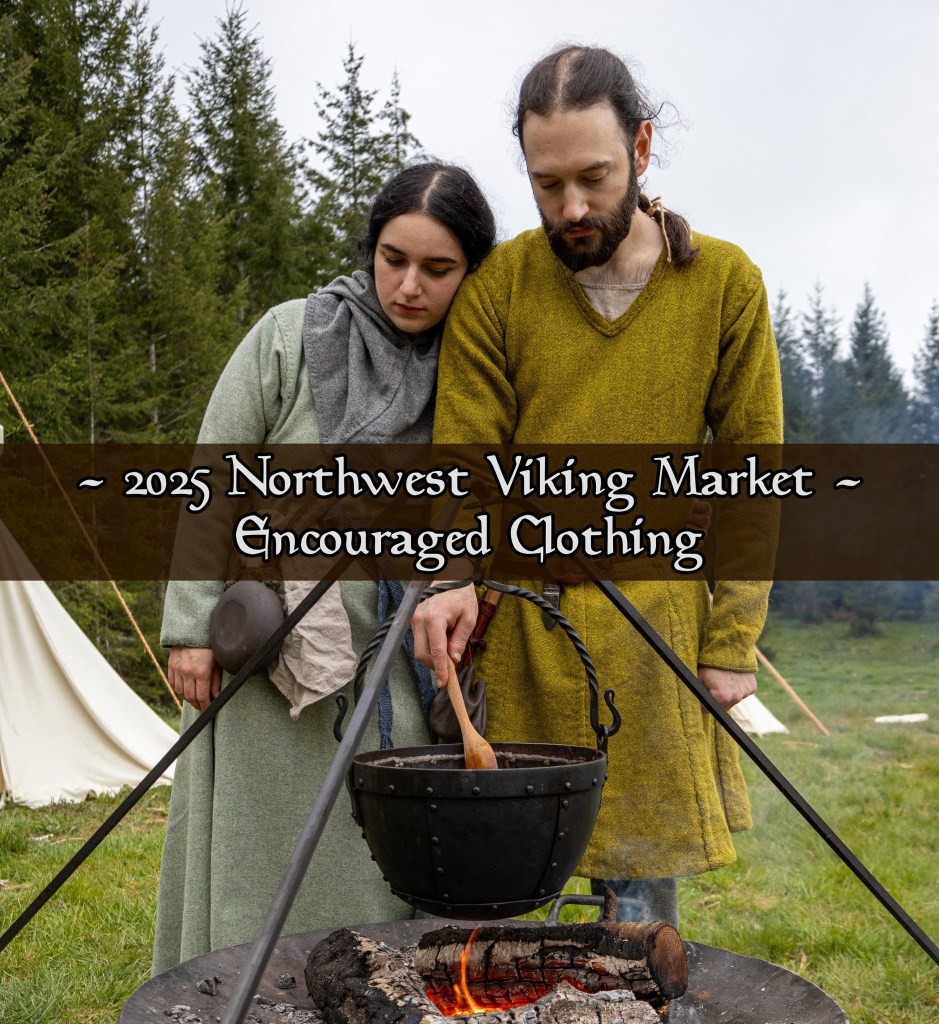
What is the dress code for guests coming to the Northwest Viking Market? Pretty much whatever they want! There is no requirement for what type of clothing people wear to the event (as long as it’s legal, anyway). For those who want to get into the theme, though, we’re happy to provide recommendations.

Via the link below you can find our Villager Standards document. This is the level of historical clothing that we have asked our villagers to meet, and which we would encourage for those who would like to dress for the theme. And while there are a multitude of patterns, materials and even ready-made items available online, feel free to reach out for more information!

Villager Clothing Standards

Lastly, to preserve the type of positive and educational atmosphere that we’re aiming for, we would appreciate if guests refrain from wearing clothing with political messages or other such themes. Any clothing with hate speech, etc. on it will result in the wearer being asked to leave.

We’re looking forward to creating a fun and immersive experience for our guests and participants, and we encourage everyone who wants to add to that atmosphere to do so!

Oct 11-12 // Dragon’s Gate Brewery // Milton-Freewater, OR

Photography: Kevin Alexandrowicz
Járnborg – Viking Age Living History

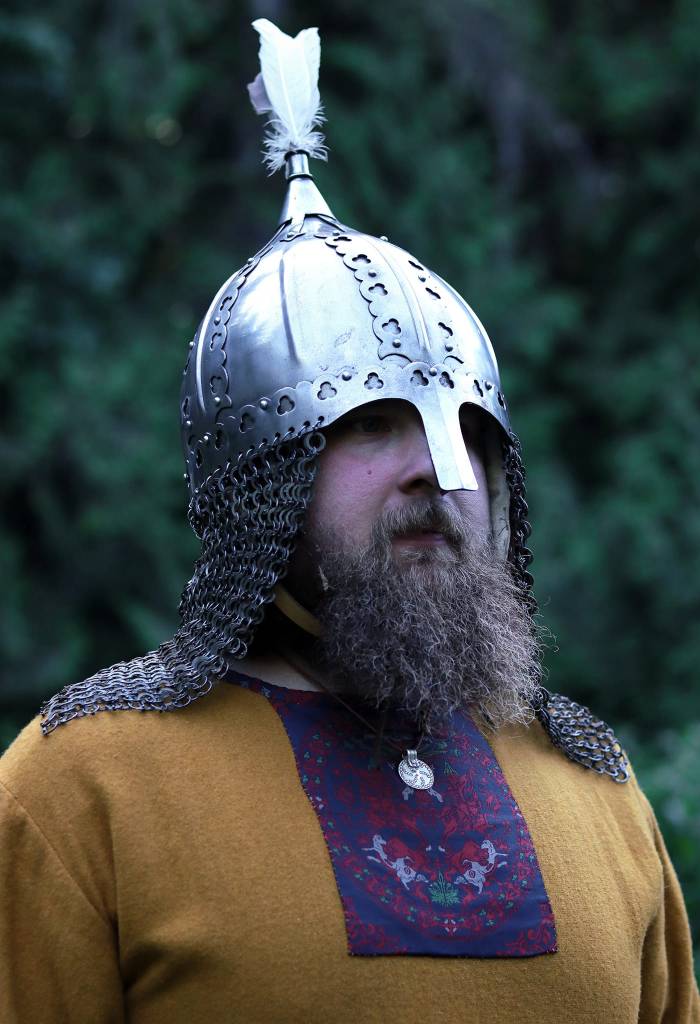
NWVA Elder William in his Gnezdovo type 2 helmet and yellow Rus tunic.


The archaeological site of Gnezdovo has produced two helmets (along with a depiction of an ocular Scandinavian type), the second being unique among eastern and western types. There is, however, a piece of a helmet band found in the garrison site at Birka which may be from the same or similar type as it has a scalloped shape, and Gnezdovo and Birka show a number of parallels.
It consists of four plates connected by a lower band with scalloped decoration and four vertical bands with similar forms, culminating in a top socketed mount which may likely have held a decorative plume of feathers or other material. The construction of the helmet is completely of steel, though the bands do have traces of some amount of gilding in their original state. There is no remaining nasal bar, which has resulted in many interpretations not having them, but the remaining structure of the helmet has enough evidence to suggest that it did originally have one. The mail aventail on this replica follows the typical pattern from the time with alternating rows of round wire riveted rings and flat solid rings which would have been punched out of a sheet.

Along with this, the tunic follows the influence of Byzantine fashions upon the upper social strata of Early Medieval Kievan Rus. The use of a silk square or rectangle at the chest was a popular form of decoration attested in illuminated manuscripts from the time such as the Menologion of Basil II.
As a final detail, shield pendants such as the one worn here and made by William were likely produced in Central Sweden, but made their way into Kievan Rus as evidenced by finds from several sites across former Rus territories.

Photo by Kevin Alexandrowicz Written by William Goetz

A NEW TYPE OF VIKING FESTIVAL IS COMING TO THE PNW!

Hello Friends!

We’ve been working on some exciting things behind the scenes, and now we can finally start spreading the news!

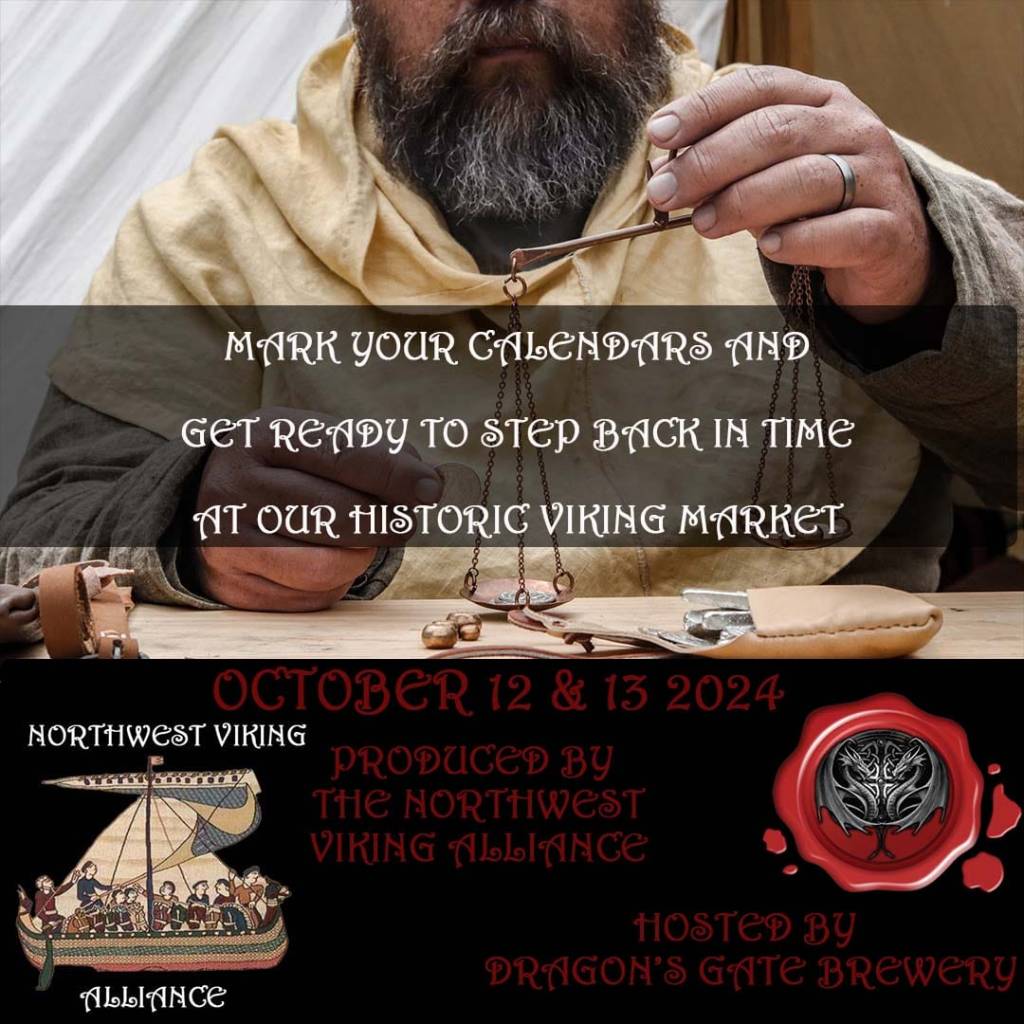
Next October we will be following through on our long-time goal of putting on a high quality viking market here in the Pacific Northwest!


The market will take place October 12th & 13th, 2024 and will be hosted by Dragon’s Gate Brewery in Milton-Freewater, Oregon just south of Walla Walla, Washington. It will feature merchants with historical reproduction wares, demonstrations of crafts and daily life, steel fighting demonstrations with historical weapons and armor and more. Plus, food and a beer garden!


Merchant & demonstrator applications and other materials will be published soon. Stay tuned for more information!

Gjermundbu Helmet: By Alliance Group Járnborg – Viking Age Living History

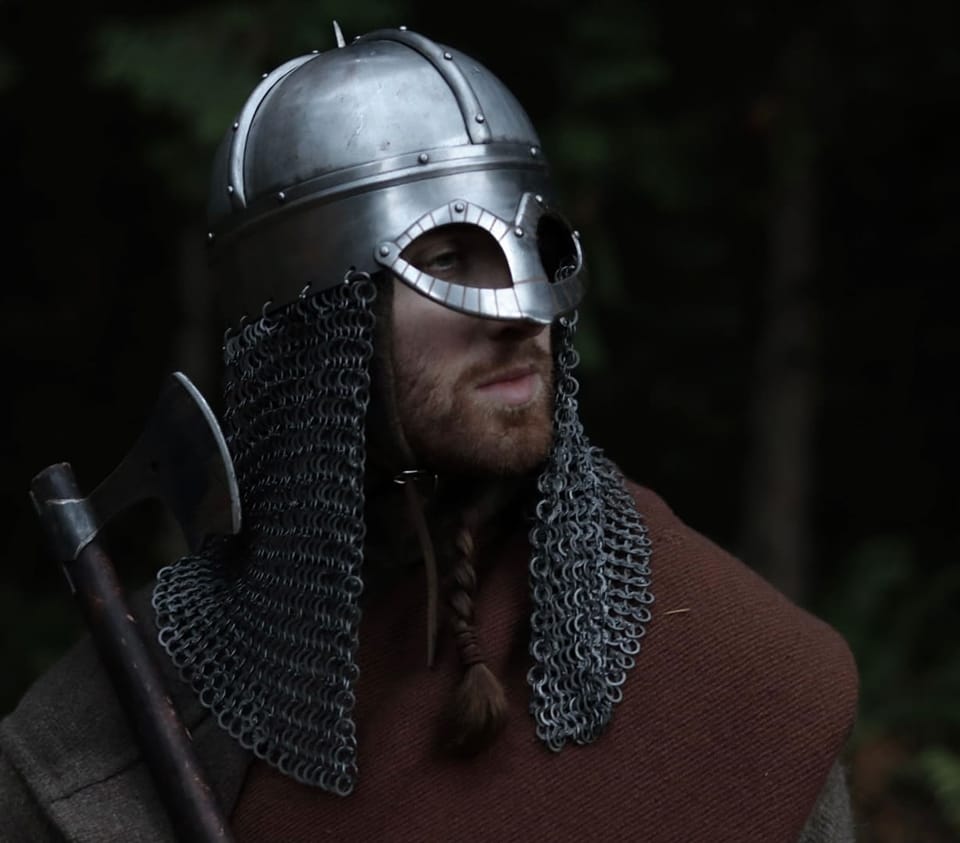
This photo features our member Kevin/Kjartan in his fighting helmet, which is a close reproduction of the helmet remains found at Gjermundbu Farm in Buskerud County, Norway in 1943 and dated to the 10th century. Contrary to popular claims, it is not the only known helmet from Viking Period Scandinavia nor is it a complete helmet (only about 25%-30% was actually found), but it is the one helmet find which is complete enough to know the overall construction.

Based on the remaining fragments, the Gjermundbu helmet consisted of four triangular plates which where hammered to fit together into a domed shape. At each joint they were sandwiched between a flat band underneath and a curved band on top, which were riveted together. A single flat band ran front to back with two separate bands for the sides, and on the front-to-back band a spike was attached at the top, centered between the four triangular plates. A broad, mostly flat band was riveted to the rim of this dome, and a mask was then attached to it at the front. The mask itself was two parts, forge welded together and riveted along the top portion. Forty lines were also incised around the eyes and across the nasal portion near the bottom, to which a lead-copper-tin alloy was applied based on trace analysis.

Around the rim, five rings were found among holes made near the edge. These have been argued as being remains of an aventail, but they were more likely part of a suspension system as the rings themselves are thicker than what is usually used for maille and they appear to have been butted rather than solid or riveted. It is possible that a maille aventail was directly suspended from these rings, or from a wire which was passed through them.

The Gjermundbu find is the most complete among several helmet related finds from Viking Period Scandinavia. Other fragments of helmet masks were found at Tjele and Lokrume, as well as one in Kyiv which was likely of Scandinavian origin. These and the Gjermundbu remains suggest that spectacle helmets were the norm in Scandinavia, and also that it was a standard for the masks to be decorated, as they all feature remains of some sort of copper alloy decoration on the steel base.

Thanks to Tomáš Vlasatý of Project Forlǫg for his excellent article which provided much of the details of the original Gjermundbu helmet. The article can be found here:

Photography and blog by William Goetz